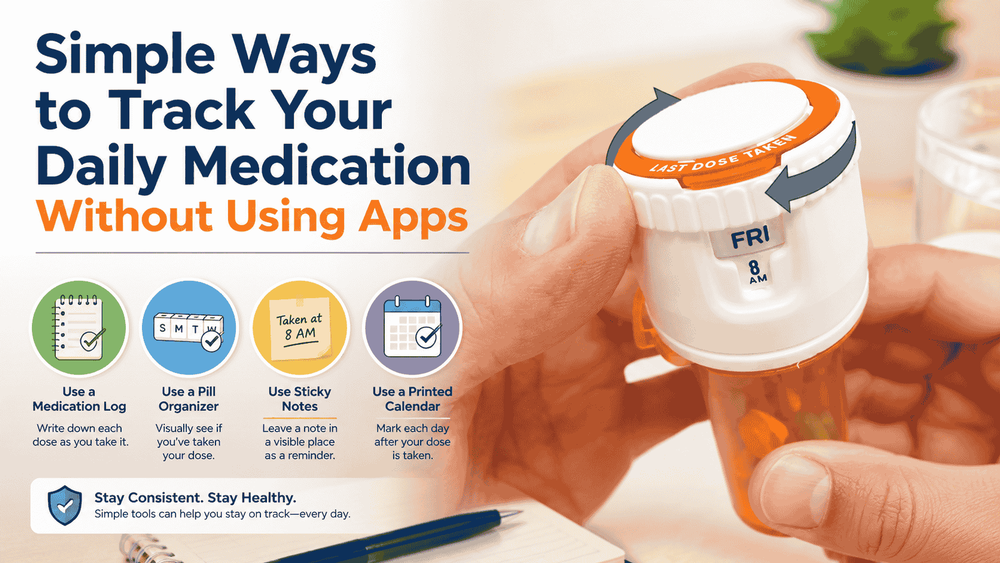
Every day management of prescriptions doesn’t need digital tools or smartphone applications. In fact, even with low-tech methods, people can conveniently and reliably maintain the dosage over time. When speaking of medication tracking, consistency offered by devices like Meticap matters more than complexity. The main aim of such devices is to create a system that naturally transforms into your habit, which reduces the chances of missing doses or repetition.
This is necessary for individuals who are facing issues with memory or attention-related conditions. If you lose track of when the dose has been taken, it can lead to various health risks, especially in mental health conditions, including ADHD medication overdose. Fortunately, practical solutions offered by Meticap that work in an app-free way exist, ensuring a safe and organized usage.
One of the most efficient solutions is the pill cap, such as those offered by Meticap. These caps are put in place of the regular lid of a prescription bottle and will record when it was last opened or when it needs to be taken next. Each time you take your medicine, you can reset the timer and start counting once again. This provides you with a simple and immediate response to a frequent question: Did I already take my dose? This tool eliminates uncertainty and thus makes medication tracking more precise, and reduces the risks of ADHD medication overdose significantly.
One of the oldest and most reliable tracking tools is still a handwritten log. It can be helpful to keep a notebook or chart in a visible area to record the doses you take. This creates a dependable history of your habit over time.
A simple log will be in a tabular form and will consist of:
This will promote awareness and responsibility, and it will be simpler to detect missed doses or discrepancies.
The use of pill organizers is popular due to the definite visual approach to drug monitoring. These boxes are separated into compartments according to days or time of the day. After being filled, it will give you a fast method of checking whether you have taken medicine or not. In case a compartment is empty, the dose has already been taken. If it hasn't, it should still be full. The plain architecture assists in maintaining a regular tracking of medications without any computer-based assistance.
Another strategy that can be used most effectively is to make medication intake conditional upon an existing habit. By relating it to something that you do on a daily basis, you will find remembering it without a reminder easier.
For example, you could:
This habitual method minimizes the use of memory as a sole means and assists in forming an ongoing pattern with time.
In some cases, even something minor that changes your surroundings can result in a big difference. Storage of medication in an area that you visit frequently serves as a reminder. An example is to have it on your bedside table or kitchen counter so that you can see it. You may also rely on such simple indicators as notes or labels to support your routine. These will not require any complex reminders, just to be seen at the appropriate time.
In case you would like a reminder that will be active and remind you, even a plain alarm clock or timer can be highly effective. These devices are not distracting, and unlike smartphone apps, they are focused. An alarm will help you not lose your reminder in the sea of notifications. It is an easy method of aiding medication monitoring, especially for individuals who are favorable to institutional encouragements.
Although more sophisticated technology is available, simpler systems for medication tracking can be more effective in the long run. They are simpler to sustain, less demanding, and can be used by anyone, irrespective of their technical capacity. There are such products as the timer caps made by Meticap, which prove that not only complex solutions are needed. Through concentrating on clarity and ease of use, they make users remain consistent and minimize the risks of missed or repeated doses.
Ultimately, a solution that fits well into your everyday routine is the best solution. With a combination of some of these approaches, you will be able to develop a trustworthy system that helps in ensuring safe and consistent medication practices.
1. What is the easiest way to track medication without using apps?
Using a pill organizer or a timer-based pill cap is one of the simplest and most effective methods for tracking medication without digital tools.
2. Can manual methods really improve medication tracking?
Yes, when used consistently, methods like written logs, pill organizers, and routine-based habits can significantly improve accuracy and adherence.
3. How can I avoid ADHD medication overdose?
You can reduce the risk by using tools that clearly show whether a dose has been taken, such as timer caps or logs, and by sticking to a consistent routine.
4. Are these methods suitable for seniors?
Absolutely. Non-digital solutions are often easier for older adults because they don’t require smartphones or technical knowledge.
5. What if I still forget to take my medication?
If forgetting remains an issue, combining multiple strategies—such as alarms and visual reminders—can help reinforce your routine and improve consistency.