Forgetting medication is more common than people admit. It does not always come from negligence. It usually comes from routine disruption.
You get busy. You get interrupted. You think you handled it. Then later, you are not so sure.
That uncertainty is frustrating on its own. But when it comes to medication, it can lead to missed doses or even taking the same dose twice.
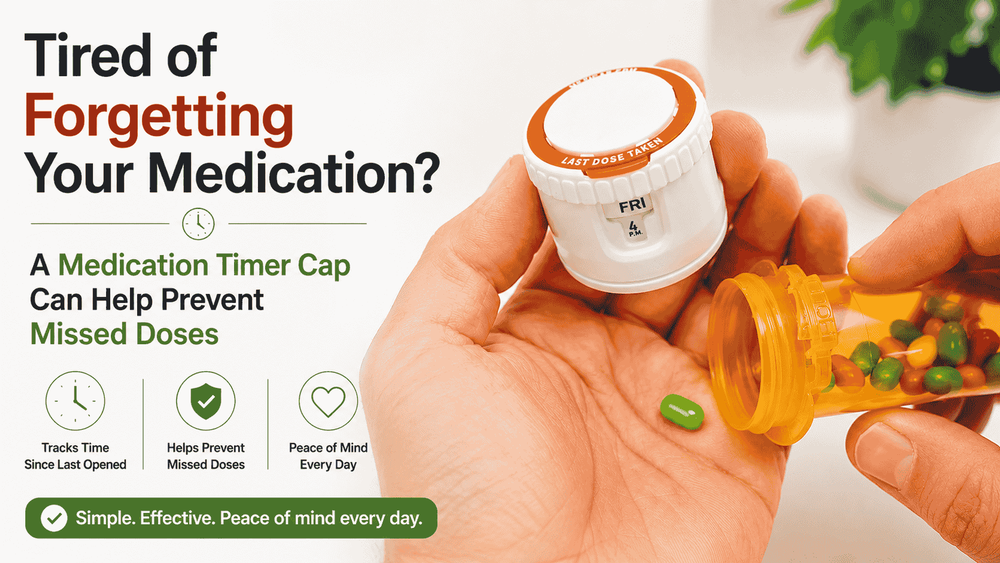
A medication timer cap is built to handle exactly this kind of everyday confusion. It does not try to remind you with alerts or notifications. It simply shows you what has already happened.
Most routines look stable on paper. In reality, they shift all the time.
For example, managing medications for children often depends on timing around school, meals, and sleep. A small delay in the morning can throw everything off.
The same applies to managing medications for daycare environments. Multiple caregivers, handoffs, and changing schedules create room for mistakes.
In managing medications for schools, the responsibility often moves between parents, teachers, and school nurses. Communication gaps are common.
In all these situations, the issue is not just remembering. It is confirming what has already been done.
A medication timer cap adds a simple but important layer of clarity.
Instead of relying on memory or verbal confirmation, it gives you a visible record on the bottle itself.
One example is Meticap. It uses a mechanical dial to display the day of the week and time of the last dose or the next scheduled dose. It attaches by screwing onto the existing 1-Clic vial cap, not replacing it, which is important because prescription caps and vials cannot be reused due to contamination risks, while Meticap itself is reusable.
There are no apps involved. No batteries. No syncing.
You just look at the cap.
The process is straightforward:
Take the medication
Adjust the dial on the cap
The cap now reflects your last dose or next dose with day and time
There is also a top ring that flips upside down to switch between tracking last dose taken or next dose due, making it simple to adjust based on dosage instructions.
That information stays in place until you update it again.
This turns the bottle into a reliable reference point. Not something you have to think about. Just something you check when needed.
At home, missed doses often happen during busy transitions.
Morning routines are a good example. Getting children ready for school, packing lunches, and managing schedules can push medication into the background.
Later, the question comes up. Was it taken or not?
With a medication timer cap, the answer is immediate. If the cap shows an older day and time, you know the dose was missed.
This helps prevent missed doses without adding extra steps to an already busy routine.
Daycare environments involve shared responsibility.
Different staff members may handle medication at different times. Verbal handovers are not always reliable, especially during busy periods.
This is where a visible system helps.
When managing medications for daycare, a timer cap provides a quick way for any caregiver to check the last recorded day and time. No need to track someone down or rely on memory.
It reduces uncertainty and keeps everyone aligned.
In schools, medication handling needs to be precise.
There are schedules to follow, documentation requirements, and multiple students to manage.
When managing medications for schools, even a small mistake can have consequences.
A medication timer cap supports accuracy by keeping day and time information attached to the medication itself.
For example, if a student visits the nurse’s office and there is any doubt about the last dose, the cap provides immediate clarity.
It acts as a simple cross-check.
Double dosing is often a result of miscommunication.
One caregiver assumes another has not given the medication. A dose gets repeated.
This can happen at home, in daycare, or in schools.
A medication timer cap helps prevent this by making the last action visible.
For example, if a parent gives a dose in the morning and a caregiver later considers giving another, the cap shows the exact day and time. That second dose can be avoided.
This applies not only to prescriptions but also to common medications like Advil, Tylenol, vitamins, supplements, or even pet medications.
It is a small step, but it removes a common source of error.
Many people try to solve tracking problems by moving medication into separate organizers.
But this can create new issues:
Labels are separated from medication
Instructions are harder to access
Safety features may be reduced
A medication timer cap works with the original prescription bottle.
This means you keep:
Clear labeling
Dosage instructions
Built-in safety mechanisms
At the same time, you add tracking using day and time visibility without changing your system.
This makes Meticap especially useful as a medication tracker for caregivers and parents who need a safer and easier way to monitor doses across busy schedules.
Meticap is built with everyday use in mind:
Mechanical system with no batteries
Attaches to the existing cap, not replaces it
Tracks day and time for last dose or next dose
Includes a flip ring to switch dosage tracking mode
Reusable across different medications
It is also available in 6, 12, and 24 packs, making it practical for families, shared caregiving environments, or even pet medication use.
There is no dependency on devices or apps. It works every time the bottle is used.
That consistency is what makes it effective.
Forgetting medication is not unusual. It is part of how daily life works. But the confusion that follows does not have to be.
A medication timer cap provides a simple way to track and confirm medication timing using clear day and time tracking. It helps prevent missed doses, reduces the risk of double dosing, and supports clearer communication across different caregivers.
Whether you are managing medications for children, handling routines in daycare, or supporting structured systems in schools, having a visible and reliable reference makes a difference.
Tools like Meticap do not add complexity. They remove uncertainty. And in medication management, that is what matters most.